Supporting growers in a changing fertilizer landscape
Agriculture has always operated within a complex global environment. Fertilizer markets have become increasingly volatile in recent years due to a combination of factors including; energy costs, global logistics disruptions, and broader geopolitical developments affecting production and supply chains.
Nitrogen fertilizers, which rely heavily on energy-intensive production processes, have been particularly affected by fluctuations in energy markets. Phosphorus and potassium fertilizers have also seen supply pressures, while micronutrient inputs such as chelates – often sourced from Asia – face growing logistics and availability risks.
For growers, these changes translate into two critical challenges:
- Rising input costs
- Uncertainty in supply
In this environment, maintaining productivity while protecting profitability requires a new approach to crop nutrition — one that focuses on efficiency, integration, and agronomic precision while managing the risk of rapidly changing input price and availabiltiy.
This is where nutrient-use efficiency (NUE) becomes a central pillar of modern farming.
Nutrient-use efficiency: producing more with less
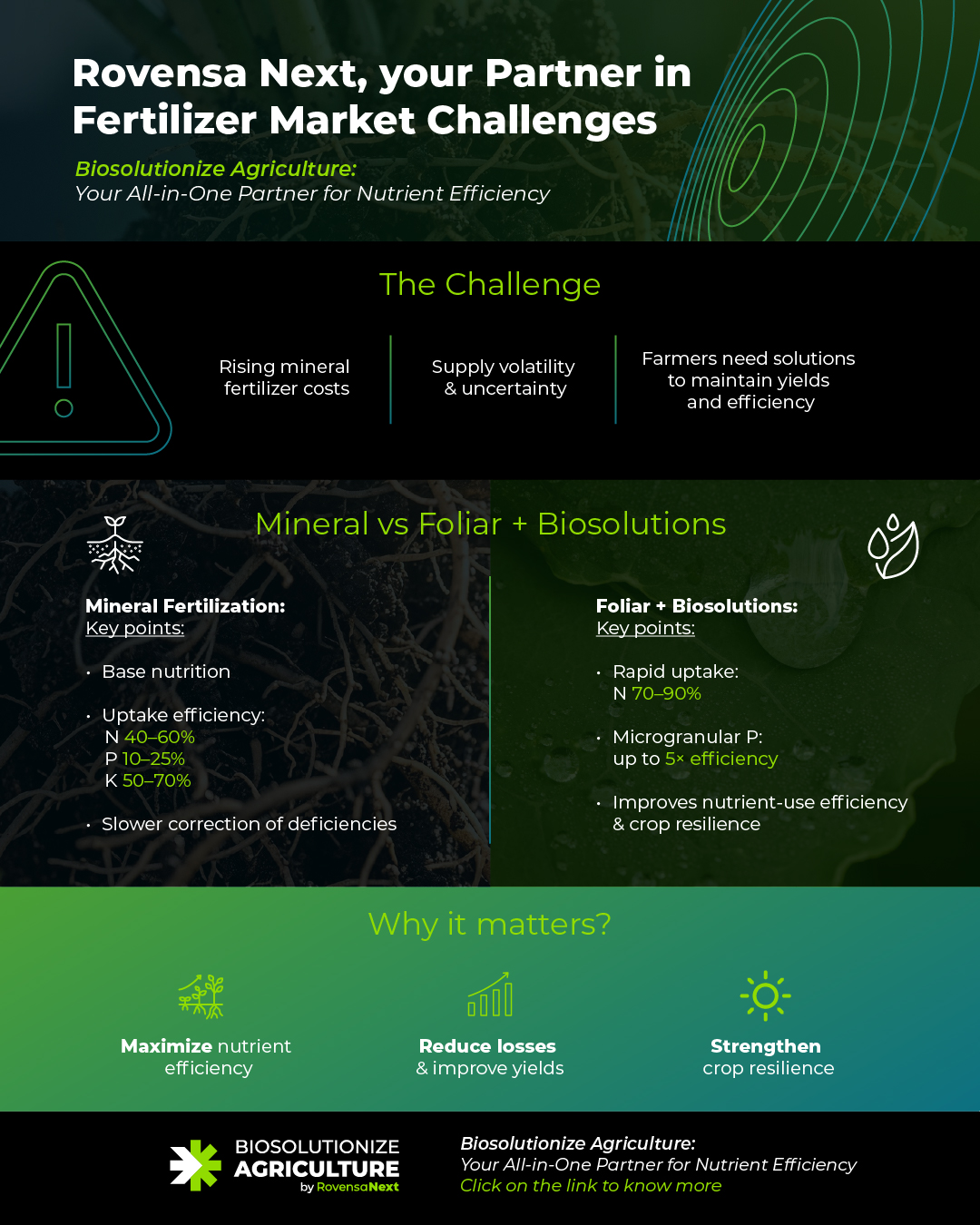
Nutrient-use efficiency refers to the plant’s ability to absorb, assimilate, and convert nutrients into yield and quality. In conventional fertilization programs, a significant proportion of applied nutrients is often lost through leaching, volatilization, fixation in the soil, and / or limited plant uptake.
Typical nutrient efficiency ranges can be relatively low:
| Nutrient | Typical Efficiency of Soil‑Applied Fertilizers |
|---|---|
| Nitrogen | 40–60% |
| Phosphorus | 10–25% |
| Potassium | 50–70% |
Improving this use efficiency offers a powerful opportunity: higher productivity without proportionally increasing fertilizer inputs.
At Rovensa Next, this philosophy is at the core of our campaign:
Biosolutionize Agriculture: Your All-in-One Partner for Nutrient Efficiency
Through integrated biosolutions, we support farmers in optimizing fertilization strategies, improving nutrient uptake, and protecting crop performance under increasingly complex agronomic conditions.
A stable and reliable partner for farmers
In the context of global supply fluctuations, stability and reliability are essential for growers and distributors alike.
Rovensa Next’s global manufacturing footprint and strong production network provide an important advantage in ensuring consistent supply and operational continuity.
Thanks to our integrated manufacturing capabilities across four continents and robust supply network, we are able to provide customers with a high level of supply reliability and operational stability, even in a volatile market environment. Our teams continue to closely monitor market developments to anticipate potential impacts and support customers with transparency and consistency.
This approach reinforces our role not only as a supplier of agricultural inputs, but as a trusted partner helping growers navigate uncertainty and make optimum agronomic decisions.
Integrated biosolutions to improve nutrient efficiency
Improving nutrient-use efficiency requires more than replacing one product with another. It involves combining complementary technologies that optimize nutrient availability, uptake, and plant metabolism.
Our portfolio supports this integrated approach through three key solution areas.
-
Optimizingnutrient programs
Efficient fertilization begins with delivering nutrients at the right time, in the right form, and with maximum plant availability.
Microgranular starters: early nutrient efficiency
Early crop development is a critical stage for phosphorus availability. Microgranular starter fertilizers applied close to the seed improve nutrient accessibility and early root development.
Key solutions include:
- Seed Sprint® range
- Nextart®
- Turbo Seed®
Microgranular technologies have demonstrated up to x3 – 5 times higher phosphorus availability compared with traditional broadcast fertilization, resulting in stronger early crop establishment and improved nutrient uptake throughout the season. This is especially important in a year such as this when growers are likely to be cutting total basal fertiliser applications.
Foliar nutrition: targeted efficiency
Foliar fertilization can significantly increase nutrient absorption compared with soil applications by delivering nutrients directly to plant tissues when they are most needed.
Research and field trials show that foliar nutrient applications can achieve absorption efficiencies between 70–90%, compared with 40–60% for soil-applied nutrients.
Rovensa Next solutions include:
- Nutrimax® range – balanced macro- and micronutrient foliar solutions
- Phostrade® range – highly efficient phosphorus and micronutrient formulations
- Final K® and Activeine® K – potassium nutrition supporting fruit development and quality
- Cosmocal® and Barrier® – calcium solutions supporting cell wall strength and crop quality
- Aton Mo® and Phosfacel® – molybdenum nutrition improving nitrogen metabolism
- Folur® range – nitrogen and sulfur foliar nutrition supporting rapid nutrient uptake
Field trials demonstrate that targeted foliar programs can improve nutrient uptake efficiency by 20–30% while supporting yield and crop quality. Foliar nutrition is also an excellent way to maintain, recovery or enhance crop trajectory if early fertilizer applications are reduced due to supply chain issues.
Sulfur nutrition and spray efficiency
Sulfur plays an important role in nitrogen metabolism and protein synthesis. Supporting sulfur availability can therefore improve overall nitrogen-use efficiency and is an economic way to ensure hard earned nitrogen spend is optimally utilized within the plant
In addition, spray adjuvants play an outsized role this year. If starting fertilizer application is reduced, crops will be off to a less vigorous start, giving weeds an opportunity to take hold. In this scenario adjuvants like:
- Detone – Pre and Post Emergent Herbicides
- Drop Tek – Pre emergent herbicides
come into their own helping ensure optimum efficiency of weed control programs early on until the plant canopy and vigor can compete with weeds.
While across the cycle other adjuvants such as Wetcit and Inex A improve spray coverage particularly when spraying in less than ideal conditions.
-
Improving nutrient-use efficiency in soil and roots
Healthy soils and active root systems are essential for maximizing fertilizer performance.
Soil and root efficiency solutions
Humic substances and root biostimulants improve soil structure, microbial activity, and root development, enabling plants to access nutrients more effectively.
Key products include:
- Humifirst® / Humistar® / H-85®– humic acids improving soil fertility and nutrient availability
- Turbo Root® and Rootex® – root growth biostimulants
- Wiibio® – microbial solutions enhancing soil biological activity
Field studies show these technologies can increase nutrient uptake efficiency by 10–20%, while improving root biomass and soil microbial activity. This translates into more marketable, yield especially in the higher priced premium quality categories (https://plaza.rovensa.com/tile/view/8957)
Biofertilizers: unlocking natural nutrient availability
Biofertilizers support nutrient availability through beneficial microorganisms that enhance biological processes in the soil.
Examples include:
- Atmo® – microbial nitrogen fixation support
- Azzofix® – improving nitrogen availability
- Phos’Up® – phosphorus-mobilizing microorganisms
These solutions can increase nutrient availability by 10–30%, reducing dependence on synthetic fertilizers while supporting soil health.
Nutrient efficiency technologies
Micronutrients and advanced formulations help address hidden hunger, where nutrient deficiencies limit yield even when visual symptoms are absent.
Examples include:
- Agrok System® range
- Chelated micronutrients
Correcting hidden deficiencies can increase crop productivity by 5–15%, depending on crop and soil conditions. A common source of this hidden hunger are dry pockets in soil, even in irrigated systems. This is where products like Transformer which increase the evenness of wetting in the soil have a role in helping increase nutrient liberation back into the soil solution where roots now absorb them.
-
Enhancing crop resilience
Efficient nutrition also depends on the plant’s metabolic capacity to absorb and utilize nutrients effectively.
Biostimulants support plant physiology, helping crops maintain nutrient uptake and productivity under stress conditions such as drought, temperature fluctuations, or nutrient imbalances.
Rovensa Next solutions include:
- Phylgreen® range – seaweed-based biostimulants improving stress tolerance
- Delfan Plus® – amino acid technology supporting nutrient assimilation
- Bimore®, Quikon®, Adrenaline®, Vorax®, Maxi-Grow Next® Frutex- next generation Biostimulants designed to enhance plant metabolic activity and nutrient assimilation.
Field evaluations show that biostimulants have demonstrated the ability to:
- Increase nutrient assimilation by 10–25%
- Improve crop resilience under stress
- Support yield stability in challenging growing conditions
Supporting farmers through integrated biosolutions
Today’s agricultural challenges require more than individual products — they require integrated crop nutrition strategies that combine efficiency, resilience, and sustainability.
Through our comprehensive portfolio and agronomic expertise, Rovensa Next helps:
- Optimize fertilization programs
- Improve nutrient-use efficiency (NUE)
- Reduce input losses
- Protect yield and profitability
Above all, our goal is to act as a trusted partner for farmers and distributors, providing reliable solutions and agronomic support in a rapidly evolving agricultural landscape.
Biosolutionize Agriculture: your all-in-one partner for nutrient efficiency.
By integrating biosolutions with modern fertilization strategies, we are helping growers build more efficient, resilient, and sustainable farming systems for the future.