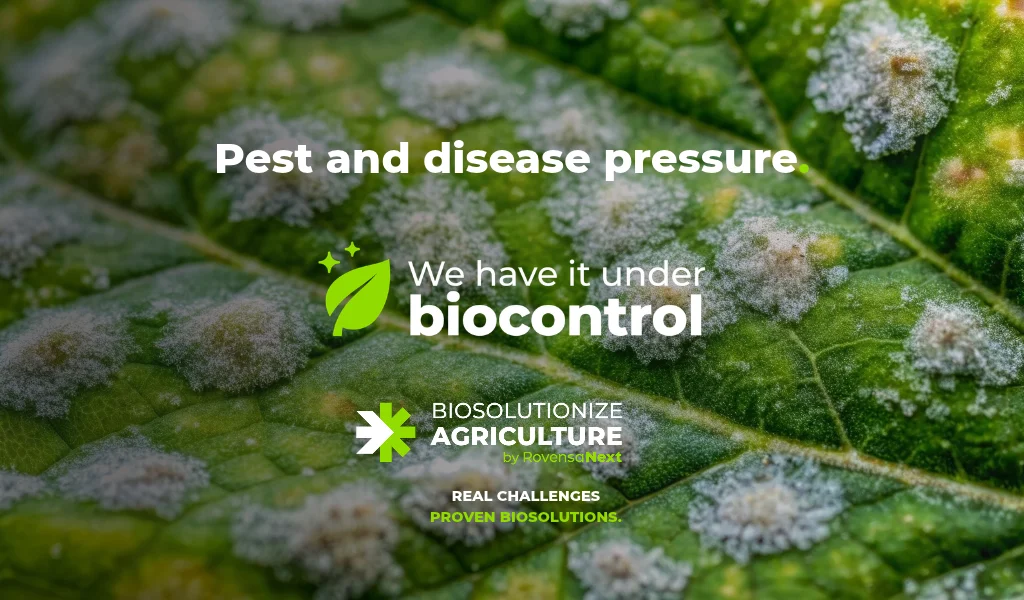
- “We Have It Under Biocontrol” expands Rovensa Next’s Biosolutionize Agriculture “Real Challenges. Proven Biosolutions.” approach to pest and disease pressure. It moves the focus from individual treatments to integrated strategies that help growers anticipate pressure and manage resistance.
- Plant pests and diseases cause losses of up to 40% of global crop production each year, according to FAO. Rovensa Next is using field evidence across different biological pressures to help growers protect crop performance.
Basel, Switzerland, October 20, 2026. Rovensa Next, the global leader in biosolutions for agriculture, today announced at ABIM the launch of “We Have It Under Biocontrol”, a new initiative designed to help growers anticipate and respond more effectively to evolving pest and disease pressure through integrated biosolutions strategies.
The initiative forms part of Biosolutionize Agriculture “Real Challenges. Proven Biosolutions.” campaign, Rovensa Next’s approach to addressing growers’ field challenges through agronomic expertise, field evidence and complementary biosolutions. Its central idea is that crop protection strategies need to go beyond the isolated use of products and anticipate biological pressure changes before crop potential is affected.
CONTROL THE PRESSURE. PROTECT THE POTENTIAL.
Pests and diseases remain one of agriculture’s largest sources of crop loss. The Food and Agriculture Organization of the United Nations (FAO), estimates that they account for up to 40% of global crop production losses each year, costing the global economy more than USD 220 billion1. Climate change is also altering pest distribution and plant-health risks as temperatures and weather patterns shift2.
Environmental and agronomic factors, such as humidity, temperature, crop stage, pest populations and resistance are some of the most challenging, and can reshape biological pressure and the best time to intervene. This reflects a broader shift in plant health toward more preventive and sustainable pest management. “We Have It Under Biocontrol” responds by moving from individual treatments to integrated strategies that help growers anticipate pressure and manage it over time.
The initiative builds on the latest phase of Biosolutionize Agriculture, which identifies nearly 30 grower challenges across five major categories, including pest and disease pressure, climate stress, soil and nutrient efficiency, crop performance and resource use.
Within pest and disease pressure, the challenges range from sudden pest outbreaks and population spikes to fungal and soil-borne diseases, as well as the growing risk of resistance. FAO guidance for major crop pests and diseases recommends combining complementary management measures rather than relying on a single intervention3.
THREE PRESSURES, ONE INTEGRATED STRATEGY
At ABIM, Rovensa Next is illustrating the approach through powdery mildew, downy mildew and mite pressure, demonstrating that pressure can change quickly, early detection matters, and no single tool covers every stage of the crop-protection cycle.
Powdery mildew can reduce photosynthetic capacity, crop growth, and quality as infection progresses. Integrated management combines prevention, direct control, and program rotation. In referenced trials, Rovensa Next’s Ospo Vi55® achieved 79%* to 94% control, depending on application rate and trial conditions.
Downy mildew is strongly influenced by humidity, leaf wetness and temperature, with infection cycles developing rapidly when conditions are favorable. In commercial cucumber evaluations under high disease pressure, Milagrum Plus® achieved up to 91% control of disease severity. The broader strategy combines anticipation, prevention, application coverage, and resistance management.
Mite populations can develop on leaf undersides and within dense canopies before damage becomes obvious, making selective intervention particularly important. In several trials, Prev-Am® powered by OROWET® Technology applied at 0.4% achieved an average 65% control of motile mite stages 3–7 days after application. Conservation of beneficial organisms and follow-up monitoring are also central to an integrated response.
Rovensa Next is also introducing Driffo®, a new anti-drift adjuvant designed to improve spraying quality by reducing off-target active ingredient loss. Wind-tunnel validation showed an average 37% drift reduction at a standard concentration of 0.1% v/v, while Brazilian university trials recorded an average 25% reduction even at an ultra-low concentration of 0.05% v/v. Its low-viscosity formulation helps preserve the spray pattern and nozzle performance, while its anti-foam properties support faster and more efficient tank filling. These examples illustrate the broader principle behind the initiative: effective biocontrol depends not only on selecting a product to face a challenge, but on connecting monitoring, prevention, intervention, application quality and resistance management around the specific crop and pressure.
A GLOBAL FRAMEWORK ADAPTED TO LOCAL CONDITIONS
The strategy provides a common global framework, while its application remains local. Crops, biological pressure, product availability and authorized uses vary by country, so Rovensa Next’s regional teams adapt the approach to local agronomic and regulatory conditions.
By combining global R&D and portfolio capabilities with local field expertise, “We Have It Under Biocontrol” extends the philosophy of Biosolutionize Agriculture from identifying the grower challenge to building an integrated response around it.
Different pressures require different tools, but the objective remains the same: anticipate pressure, act with precision, and achieve the best crop performance to help growers in their journey.
* Product availability, registrations, authorized uses, crops and claims vary by country. Efficacy figures cited above refer to specific products, crops, application rates, assessment timings and trial conditions. Always follow the local label.
About Rovensa Next
Rovensa Next is the global leader in biosolutions for agriculture. With over 2,200 employees spread around the world, Rovensa Next markets its products in over 90 countries. It brings together a global network of 39 R&D laboratories, excellence centers, fields, and greenhouses, 12 production plants, over 170 partnerships with research centers and universities, 100 R&D and innovation specialists and a dedicated team of more than 850 field experts.
Rovensa Next markets the broadest biosolutions portfolio in the industry, including biostimulants, biofertilizers, bionutrition, biocontrol, and adjuvants. The company builds on innovative technologies and farming practices, supporting distribution partners and growers with holistic solutions to increase profitability, boost yields and maximize performance.
Rovensa Next is the result of the integration of twelve pioneering sustainable companies with decades of successful track record in biosolutions: Agrichembio, Agro-K, Agrotecnologia, Cosmocel, Idai Nature, Microquimica, MIP Agro, Oro Agri, OGT, Rodel, SDP, and Tradecorp.
For more information, please visit us on www.rovensanext.com or reach out to:
Elisa Lipperheide
Global Communication Manager
Elisa.lipperheide@rovensanext.com
Sources
- Food and Agriculture Organization of the United Nations (FAO), “Plant Production and Protection: About”, accessed October 2026. Plant pests and diseases cause losses of up to 40% of global crop production annually, with economic losses exceeding USD 220 billion.
https://www.fao.org/plant-production-protection/about/ - International Plant Protection Convention (IPPC), “How climate change impacts plant health and why it matters for One Health”, July 22, 2025. On the effects of climate change on pest distribution and plant-health risks.
https://www.ippc.int/en/news/how-climate-change-impacts-plant-health-and-why-it-matters-for-one-health/ - Food and Agriculture Organization of the United Nations (FAO), “Guidance on integrated pest management for the world’s major crop pests and diseases”, May 26, 2025.
https://www.fao.org/science-technology-and-innovation/resources/publications/guidance-on-integrated-pest-management-for-the-world-s-major-crop-pests-and-diseases/en