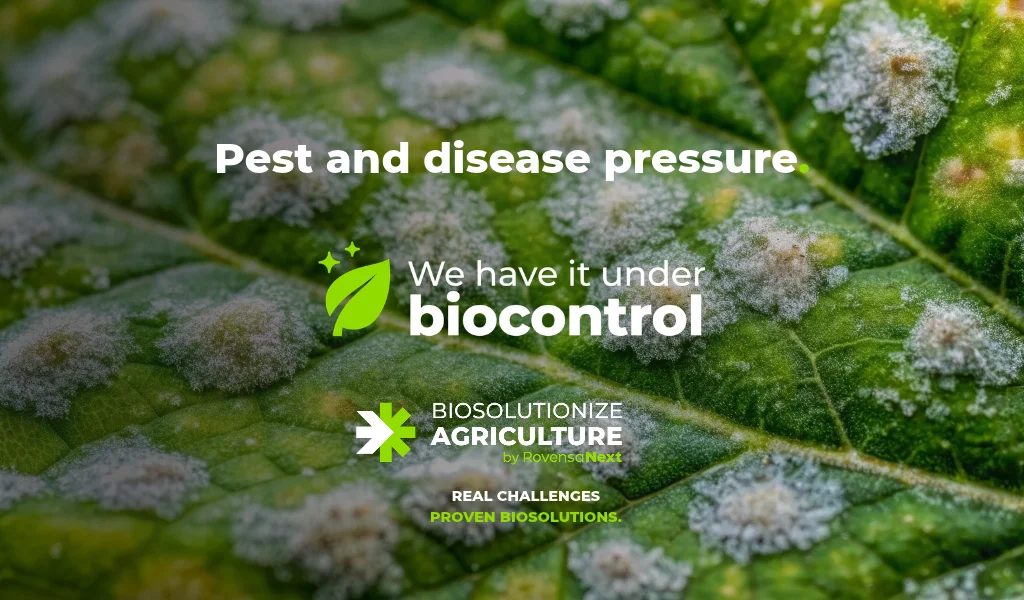
Orange oil can help growers protect yield potential and crop quality by reducing inoculum pressure and limiting the establishment of new infections. This contributes to more efficient crop protection strategies and supports overall production profitability when included in preventative disease management programs.
When growers think about orange oil, they usually associate it with the control of soft-bodied insects such as whiteflies, aphids, mealybugs, and mites.
However, some of its most valuable contributions occur beyond insect control.
Orange oil can play an important role in disease management by reducing inoculum, suppressing spores, and interfering with key stages of pathogen development before infections become established. This preventative contribution makes it a valuable component of integrated crop protection and disease management programs.
Key takeaways
- Orange oil contributes to disease management through inoculum reduction and spore suppression.
- Its physical mode of action disrupts exposed fungal structures and reproductive organs.
- Orange oil helps manage powdery mildew, downy mildew, and other fungal and oomycete diseases.
- Its broad-spectrum activity is effective against insects, mites, fungal pathogens, and oomycetes.
- Reducing inoculum pressure helps decrease the risk of infection, reinfection, and disease spread.
What is orange oil and how does it support disease management?
Orange oil is widely recognized as a natural solution for insect control. However, research and field observations show that its benefits extend beyond insect management.
Orange oil contributes to disease management by reducing inoculum, suppressing spores, disrupting fungal structures, and limiting the establishment of new infections through its physical mode of action.
Disease management begins long before signs appear. Visible symptoms are often the final stage of a biological process that starts when infective structures land on plant surfaces, germinate, and establish new infections.
For this reason, effective disease management strategies focus on symptom control and on reducing the biological drivers that initiate disease outbreaks.
The hidden role of inoculum
In plant pathology, inoculum refers to the infective structures capable of initiating disease. These structures may include:
- Spores
- Mycelial fragments
- Reproductive structures such as sporangia and fruitification bodies
Inoculum is the engine that drives disease epidemics. The larger the inoculum reservoir, the greater the likelihood of infection, reinfection, and disease spread.
Reducing inoculum pressure has therefore long been recognized as a fundamental disease management strategy. Many preventative agronomic practices, including crop rotation and the destruction of infected crop debris, are ultimately designed to achieve this objective.
Why spore suppression matters
In many fungal and oomycete diseases, spores are responsible for survival, dispersal, infection, and the spread of disease.
Disease cycles cannot continue without viable spores. Infection cannot occur without successful germination.
This is why spore suppression remains one of the most important preventative strategies available to growers. Disease pressure can be lowered before yield or crop quality are affected by reducing the viability of infective structures before symptoms appear.
How orange oil interrupts disease cycles
Orange oil acts through physical contact.
Rather than targeting specific metabolic pathways, it interacts directly with fungal structures, including spores, mycelium, and reproductive structures, by disrupting their membranes. This disruption and the resulting desiccation of exposed fungal tissues reduce spore viability and inoculum load while limiting the establishment of new infections.
Its contribution to disease management includes:
- Reduction of viable inoculum
- Reduction of viable spores
- Inhibition of spore germination
- Desiccation of exposed fungal structures
- Suppression or eradication of exposed mycelium
As this mode of action uses direct physical contact, robust spray coverage remains essential to maximize efficacy.
Powdery mildew: acting across the disease cycle
Powdery mildew is a good example of how contact-active technologies can contribute to disease management.
As an ectoparasitic fungus, powdery mildew develops externally on the plant surface. This makes several stages of its life cycle directly accessible to contact treatments.
Technical observations have shown visible desiccation and collapse of fungal mycelium, with significant degradation of fungal structures within 48 hours after treatment.
Orange oil acts directly on exposed fungal biomass, contributing to:
- Inhibition of active mycelial growth
- Suppression of reproductive structures
- Reduction of subsequent disease spread
In practical terms, this means disease pressure can be reduced at multiple stages of the pathogen’s life cycle.
This physical, multi-target mode of action also gives orange oil a complementary role in resistance management strategies. As it acts through direct contact rather than via a single biochemical pathway, it can be integrated into fungicide programs to help diversify disease control approaches and reduce reliance on site-specific fungicides.
Downy mildew: targeting reproductive structures before infection
Downy mildew presents a different biological challenge.
Unlike powdery mildew, these pathogens develop largely within plant tissues. However, their reproductive structures emerge externally during sporulation, creating an opportunity for intervention.
Orange oil technology can act on:
- Sporangia and infective spores prior to germination
- External fructification bodies involved in pathogen dissemination
Research conducted by Wageningen University on Phytophthora infestans demonstrated that orange oil 60 g/L applied at both 0.4% and 0.8% prevented zoospore emission and inhibited germination.
These findings illustrate a key principle of disease management: preventing infection is often as important as controlling existing infections.
This contribution is particularly relevant when applications are timed preventively and directed at exposed reproductive structures involved in pathogen dissemination.
Multi-target protection against multiple biological threats
Pests and diseases rarely occur in isolation in agricultural systems.
A vineyard with powdery mildew may simultaneously experience mite pressure, while vegetable crops often suffer both insect infestations and pathogen challenges during the same production cycle.
The broad-spectrum efficacy and non-specific mode of action of orange oil technologies make them effective against multiple target groups, including:
- Insects
- Mites
- Fungal pathogens
- Oomycete pathogens
This broad-spectrum activity helps growers integrate pest and disease management objectives within a single crop protection strategy while supporting more holistic crop health programs.
Evidence from fungicide efficacy trials
The orange oil platform is supported by a database with over 2,000 efficacy trials conducted worldwide.
Commercial orange oil formulations containing orange oil 60 g/L, including PREV-AM®, PREV-GOLD®, Orocide, Oroquin® and Oroganic, consistently demonstrated activity against economically important diseases in over 80 GEP trials conducted on grapevines, apples and potatoes.
- Grapevine downy mildew
PREV-GOLD® achieved efficacy levels of up to 75.7% on leaf infection severity and 74.4% on bunch infection severity across 18 GEP field trials conducted between 2019 and 2020, involving 8-12 consecutive applications during the disease risk period.
- Apple powdery mildew
PREV-GOLD® achieved efficacy levels of up to 68.5% on leaf infection severity
across 20 GEP trials conducted in multiple European regions, with five consecutive applications during the infection risk period.
- Potato late blight (Phytophthora infestans)
In 30 European GEP trials conducted between 2017 and 2020, orange oil technology achieved efficacy levels of up to 62.7% during the early stages of disease development, when preventative intervention has the greatest impact on epidemic progression.
These results reinforce the value of inoculum reduction, spore suppression, and preventative intervention as components of integrated disease management programs.
Why orange oil matters in modern crop protection
Modern crop protection is increasingly focusing on prevention rather than reaction.
Orange oil supports this approach by targeting critical stages of pathogen development, including inoculum survival, spore viability, and disease establishment.
Orange oil can also complement resistance management strategies by helping diversify disease control approaches and reducing reliance on site-specific fungicides because it acts through direct physical contact rather than through a single biochemical pathway.
Its ability to contribute simultaneously to pest and disease management aligns with the growing demand for integrated crop protection solutions capable of addressing multiple biological challenges while supporting long-term crop health.
The value of inoculum reduction and spore suppression should be considered as part of a preventative disease management approach aimed at reducing disease pressure before infection cycles become established.
Looking beyond insect control
For many years, orange oil has primarily been associated with insect management.
Yet available evidence points to a broader role.
Its contribution to inoculum reduction, spore suppression, desiccation of exposed fungal structures and interruption of disease cycles positions orange oil as a valuable tool within modern disease management programs.
As growers increasingly seek integrated strategies capable of addressing multiple biological threats, the ability to combine insect, mite and disease management benefits within a single solution becomes increasingly relevant.
Our integrated biosolutions approach helps growers implement preventative crop protection strategies designed to reduce disease risk before infection becomes established.
As with any contact technology, performance depends on suitable coverage and direct exposure of target structures to the spray solution. This highlights the importance of application timing and spray quality when integrating orange oil into disease management programs.
Disease management begins long before symptoms appear. Reducing inoculum means reducing risk.