Forecasts indicate that El Niño is likely to develop during the second half of 2026, and could potentially turn into a strong “Super El Niño” event. While its eventual intensity remains uncertain, the expected transition from La Niña to El Niño conditions is likely to increase climate variability, posing significant challenges for agriculture worldwide.
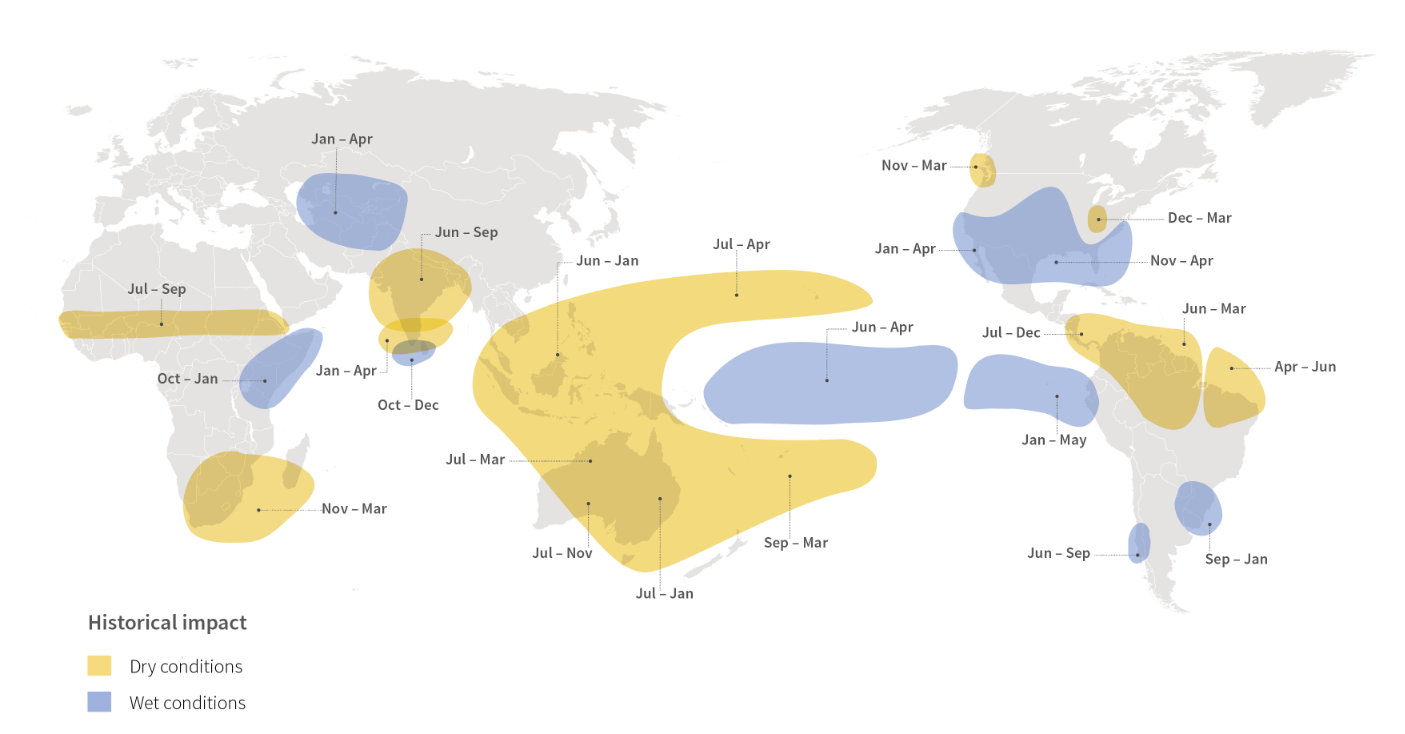
El Niño alters rainfall and temperature patterns globally, bringing drought to some regions and heavy rainfall to others. Against a backdrop of already elevated global temperatures, these effects may intensify, increasing both water scarcity and extreme rainfall events.
For agriculture, this creates a dual challenge: managing both water deficits and excess water, depending on the region and cropping system.
Brazil: contrasting climate impacts and resilience strategies
Across this region, El Niño typically leads to contrasting climate patterns depending on the area, with above-average rainfall in the South increasing the risk of flooding, soil saturation and disease pressure, while Northern and Northeastern areas often face drought and water scarcity. Central-West and Southeast regions may experience irregular rainfall and prolonged dry spells, affecting crop establishment and development.
Previous El Niño events have had significant impacts on agriculture, including reductions in soybean yield and grain quality in the South due to waterlogged soils, as well as yield losses in second-crop corn in key production areas such as Mato Grosso and Goiás, where disruptions in planting windows and dry conditions during establishment have led to productivity losses exceeding 20%.
Against this backdrop, strengthening climate resilience requires an integrated approach combining sound agronomic management, climate-based decision-making and innovative biosolutions. Adjustments to planting calendars can help reduce exposure to extreme conditions, while the selection of tolerant cultivars supports crop stability under drought, waterlogging and disease pressure.
Biosolutions play a key role in this strategy. Improving water-use efficiency and soil water availability is essential to maintain plant metabolism under stress conditions. This is supported by Transformer Ultra, which helps optimize water management and sustain physiological activity. Enhancing root development is also critical, with Ruter AA promoting stronger root systems and early crop establishment. Preparing crops ahead of stress conditions is equally important, with Phylgreen, with Primactive Effect, helping to prime plants against oxidative stress, and Pumma which supports cellular water balance and stress tolerance, enabling crops to better withstand drought and heat stress associated with El Niño conditions.
Mexico: contrasting seasonal risks and targeted biosolutions strategies
In Mexico, El Niño 2026 may generate differentiated impacts across regions. From June to September, the Pacific side could face intense rainfall, flooding risks, crop delays and increased pest and disease pressure, while the Atlantic region may experience fewer but more destructive storms affecting tropical crops. Northern areas may also experience excess radiation and heat stress.
In winter, localized droughts may follow heavy rains in the Pacific, affecting irrigated crops and fruit flowering, while the Atlantic region could face cold fronts, low-temperature stress and coastal salinization.
To address these conditions, biosolutions strategies focus on soil structure, water management, root development and plant resilience. Under excess water, solutions such as H85, Interaktor and Biomax Solum support soil drainage, while Rootex Sense and HolobiON, together with Fertigro+, enhance root performance and energy balance. Foliar strategies include Barrier, Phylgreen, MaxiKare, Aminocel, Maxi-Grow NEXT and Delfan Plus, while Konclude, Agro-K and Barrier help maintain water flow to leaves and fruits. Nutritional balance is supported through Mainstay Calcio, Mainstay Magnesio, Fertigro Potasio and Tradecorp chelates, which help correct imbalances under persistent high soil moisture conditions following flooding, where biomass is not reduced but excessive vegetative growth may occur, and where a nitrogen-free nutrient approach becomes particularly relevant to avoid further vegetative stimulation. Florastart, Kelatex Ca+B, Agro-K and Quikon support flowering, fruit set and growth.
Under drought and high radiation, improving soil water retention with Transformer, H85, Interaktor and BioMax Solum is key, combined with Rootex Sense and HolobiON and Fertigro+. Solutions such as Konclude, Luxyva and Quikon support fruit development, radiation protection and recovery under stress, with local adaptation remaining essential.
Contrasting climate impacts across other areas of Latin America
While Brazil and Mexico are addressed separately due to their scale and specific dynamics, the following section covers the main expected impacts across the rest of Latin America.
It is expected to generate diverse impacts across Latin America. In Southern South America, particularly Argentina, there is also a possibility of La Niña-like conditions, which are typically associated with above-normal rainfall.
Across the region, El Niño 2026 may drive a combination of excess rainfall, drought, heat stress and irregular weather patterns, directly affecting crop development, flowering, productivity and overall plant performance depending on local conditions.
In Chile, high rainfall combined with frost risk may cause physiological stress in citrus crops, affecting flowering and productivity. In Peru, high temperatures, irregular rainfall and increased pest pressure may impact crops such as blueberries, mangoes and citrus.
In Central America, higher temperatures, increased evapotranspiration and reduced rainfall across the Dry Corridor may create strong drought pressure on crops such as maize, beans, sugarcane, coffee and bananas, requiring strategies focused on maintaining plant growth and resilience under water stress conditions.
Similarly, coastal areas in Ecuador may experience excess rainfall and waterlogging, particularly affecting banana crops, while highland regions may face temperature variability and abiotic stress impacting crops such as potatoes, avocados and flowers. In Colombia, reduced rainfall, high temperatures and water scarcity may affect crops such as bananas, flowers and avocados, limiting root development, water availability and crop performance.
To address these challenges, biosolutions strategies focus on supporting plant resilience, root development, water management and physiological balance under stress conditions. Solutions such as Amiglyn support tolerance to cold and dehydration, while Phylgreen enhances metabolic activation and plant resilience across different stress scenarios.
Root development and nutrient uptake are supported by Rootex, while soil moisture management is reinforced through Humistar. Maintaining plant growth and vigor under adverse conditions is achieved with Maxikare, complemented by Barrier to strengthen plant structure and resistance.
In more specific scenarios, solutions such as Florastart, Maxigrow, Fertigro with Brotone and Agro-K support flowering and growth balance, while Delfan and Delfan Plus help plants respond under stress. In addition, Calcio Sprint and Mainstay Ca contribute to tissue stability, while Lecitec supports tissue integrity and fruit quality, and Suntec helps protect against radiation and heat stress.
A preventive and integrated approach combining root strengthening, water management and stress mitigation is key to maintaining productivity under El Niño conditions across Latin America.
Integrated Pest and Disease Management: the growing role of biocontrol
Beyond abiotic stress, El Niño conditions often lead to increased pest and disease pressure, as crops become more vulnerable under drought, heat and erratic weather patterns.
In this context, biocontrol solutions are becoming a key pillar of sustainable crop management, playing a critical role within Rovensa Next’s biosolutions programs. These solutions allow farmers to protect crops effectively while maintaining environmental balance and supporting long-term soil and ecosystem health.
Rovensa Next offers a broad portfolio of high-performance biocontrol solutions, with a strong focus on two strategic categories:
- Biofungicides, based on beneficial microorganisms or natural substances, help prevent and control fungal and bacterial diseases while preserving ecological balance. Solutions such as Portento, Ospo Vi55 and Naturdai MIM provide both preventive and curative activity against key diseases such as powdery mildew and Venturia spp.
- Bioinsecticides, formulated with microorganisms, plant extracts or naturally occurring substances, offer effective control of insects and mites under challenging conditions. Products such as Prev-Am, Bio-Neem, Tec-Fort, Tecbom, Santem and Thymic deliver reliable performance while supporting integrated pest management strategies.
In addition, versatile solutions such as Naturdai MIM act as a natural protective shield, enhancing crop resilience under stress conditions.
By integrating biocontrol with biostimulation and nutrition strategies, growers can:
- maintain crop protection under stress conditions
- reduce pest and disease outbreaks
- optimize crop performance and yield
- support more sustainable and resilient farming systems
This holistic approach is essential under El Niño scenarios, where multiple stress factors interact and require integrated, flexible and sustainable solutions.
El Niño 2026 will bring contrasting challenges across the Americas, requiring localized responses. From drought management to excess rainfall adaptation, biosolutions play a key role in helping farmers protect yields and ensure crop resilience.
For region-specific recommendations, contact your local Rovensa Next technical team to develop a tailored biosolutions program.
👉 In Part 2, we explore how El Niño 2026 impacts Africa and Asia, and the strategies needed to face even more extreme conditions.
Sources and references
Figures:
¹ Figure 1 – El Niño trends
https://www.fao.org/el-nino/en/
² Drought stress response diagram
Sources:
¹ BBC Mundo – “Super El Niño” (2026)
https://www.bbc.com/mundo/articles/cvgz4dx1yeno
² BBC News – El Niño and La Niña explained
https://www.bbc.com/news/articles/cj97npgk92po
³ FAO – El Niño overview and impacts
https://www.fao.org/el-nino/en/
⁴ Euronews – Super El Niño and climate extremes
https://www.euronews.com/2026/03/31/a-super-el-nino-inside-the-weather-phenomenon-that-could-send-temperatures-soaring
⁵ United Nations University – El Niño in a warming world
https://unu.edu/ehs/article/what-el-nino-and-why-does-it-matter-warming-world
⁶ National Geographic – El Niño impacts
https://www.nationalgeographic.com/environment/article/super-el-nino-extreme-weather-climate
⁷ FAO Open Knowledge – El Niño regional impacts
https://openknowledge.fao.org/items/b1c36f0b-a6df-4e3d-83b1-8e6448de6efe
⁸ New York Times – El Niño and global warming
https://www.nytimes.com/2026/05/04/climate/el-nino-global-warming.html
⁹ WMO – ENSO overview
https://wmo.int/topics/el-nino-la-nina