Soil health has become a cornerstone for the future of agriculture. Healthy soil boosts crop productivity, improves nutrient use efficiency, increases resilience to abiotic stress, and ensures long-term sustainability. At Rovensa Next, soil regeneration is the core of the Biosolutionize Agriculture campaign, a global strategy that helps growers transition toward more sustainable, profitable, and biologically driven production systems.
This strategic priority becomes especially relevant when considering current global soil‑health trends. Recent estimates suggest that soil erosion affects around 35.9 billion tons of soil each year, influenced in part by land‑use changes and agricultural practices that need to become more sustainable. At the same time, the FAO reports annual losses of approximately 10 million hectares of forest cover, which reduces natural soil protection.
In this context, Rovensa Next is actively developing and delivering science‑based solutions across its portfolio to support growers in protecting soil, improving crop performance, and fostering long‑term sustainability.
The three dimensions of soil health
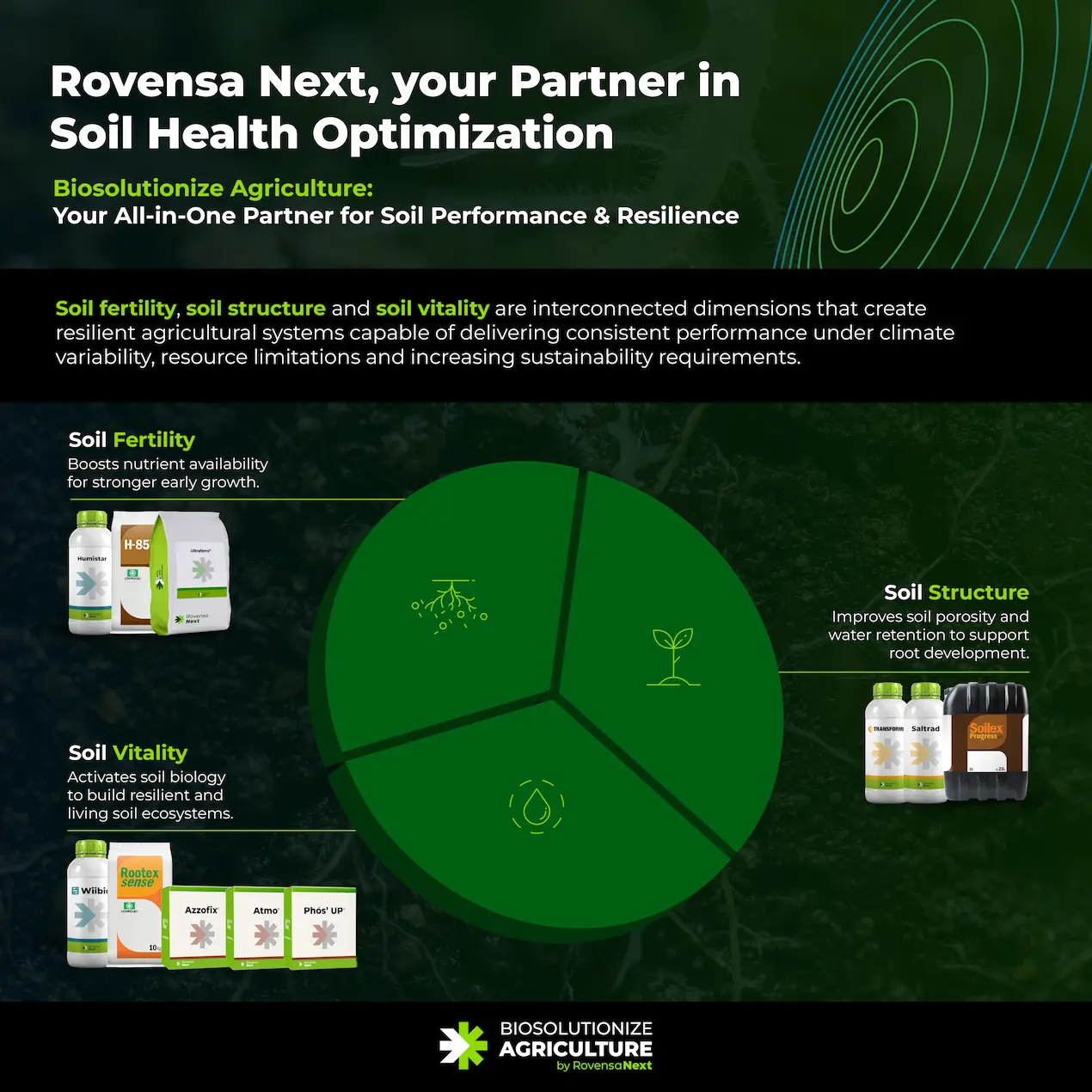
Soil health is built upon three interconnected dimensions: soil fertility, soil structure, and soil vitality. Strengthening these dimensions creates resilient agricultural systems capable of delivering consistent performance under climate variability, resource limitations, and increasing sustainability requirements.
1. Soil fertility: optimized nutrient availability and biological efficiency
Understanding fertility
Soil fertility is more than the presence of nutrients. It involves the soil’s ability to solubilize, retain, and mobilize nutrients efficiently, ensuring optimal root uptake and strong plant development. Organic matter, humic substances, and microbial activity play crucial roles in improving nutrient efficiency.
Humic and fulvic acids enhance fertility and play a key role in soil structure
Humic acids play a key role in restoring soil structure by improving aggregation, enhancing water penetration, and boosting soil microbiota. Rovensa Next solutions, such as Humistar and Humistar WG, based on concentrated humic and fulvic acid extracts, reinforce physical resilience by increasing root biomass, improving soil aeration, and supporting rhizosphere activity.
These improvements support Biosolutionize Agriculture through better water-use efficiency, healthier soils, and more resilient production systems.
Rovensa Next strengthens soil fertility through advanced humic technologies
- Humistar and Humistar WG: humic-fulvic acid biosolutions derived from high‑purity American leonardite that increase solubility, improve cation exchange, and enhance fertilizer-use efficiency.
Trial results:
• Up to +4.9% water retention in sandy soils (14 days after application)
• +22% vegetative development in clay soils
• +27% vegetative development in sandy soils
- H‑85: a concentrated wettable powder (850 g/kg humic and fulvic acids) that improves microbial activity, enhances calcium and magnesium solubility, and activates nutrients locked in the soil. H‑85 has achieved a solid, well‑established position in the Mexican market, where it is widely recognized for its reliability and consistent field performance.
Trial results:
• Increased leaf size
• Higher fruit weight in strawberries
• Enhanced sugar content in strawberries and maize
Complementary fertility enhancers
Rovensa Next offers additional solutions within the Biosolutionize Agriculture framework that support nutrient availability and soil fertility:
- Tradecorp Fe: EDTA‑chelated iron for correcting deficiencies.
- Ultraferro: EDDHA-chelated iron for use in alkaline/calcareous soils.
- Phós’UP: phosphorus-solubilizing formulation for releasing bound phosphorus.
Enhancing soil fertility not only improves yields but also reduces dependency on synthetic fertilizers and is fully aligned with the principles of Biosolutionize Agriculture.
2. Soil structure: physical resilience and water dynamics
Soil structure determines aeration, infiltration, hydraulic conductivity, and root penetration. Even nutrient-rich soils can underperform when compacted or affected by salinity and sodicity. Restoring their physical structure is essential for improving water flow and root performance.
Improving structure and correcting compaction
- Transformer restores the soil’s air–water balance, enhances infiltration, reduces compaction, and improves root-zone respiration.
Trial results:
• +11.2% yield increase in sunflowers (+380 kg/ha)
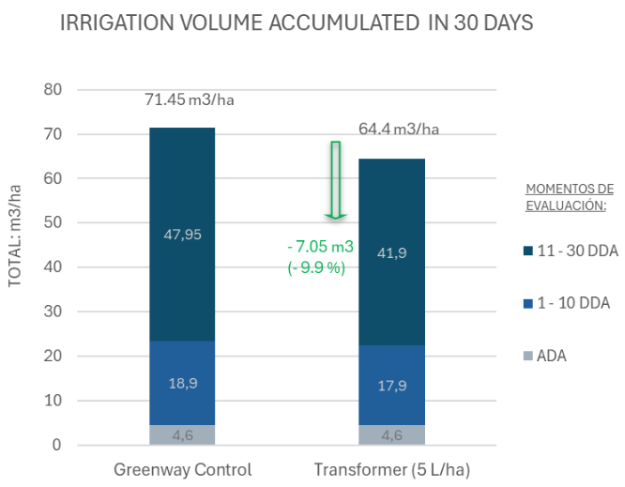
• 5 L/ha of Transformer reduced cumulative irrigation volume in blueberries grown on substrate in Piura (Peru) by –7.05 m³/ha during the first month while maintaining moisture levels equivalent to the control.
Managing salinity and sodicity
- Soilex improves soil affected by salinity or sodicity by accelerating sodium–calcium exchange, reducing electrical conductivity, and enhancing aggregate formation.
- Saltrad supports structural improvements in saline and sodic soils, promoting better water flow and overall soil function.
Trial results:
- Saltrad (Egypt, 2007): +50% peanuts per plant vs. control (27 vs. 18), with improved leaf density and fruit quality under sprinkler irrigation.
3. Soil vitality: biological activity and root–soil synergy
Soil vitality represents the living dimension of soil, microbial diversity, nutrient cycling, root–microbe interactions, and organic matter transformation. It is essential for regenerative agriculture and for restoring soil productivity over time. Soil microorganisms play a crucial role because they drive nutrient mineralization and availability, enhance root growth through symbiotic processes, and help suppress soil‑borne pathogens. They sustain soil structure, fertility, and long‑term productive capacity by maintaining these biological functions.
Biological and root-enhancing biosolutions
Rovensa Next supports soil vitality with biological enhancers and technologies:
- Galactek. Our newly launched product in USA is a root‑performance enhancer formulated with organic acids and Metabol‑8 technology, improving root branching and nutrient uptake.
- Wiibio. A biofertilizer based on Bacillus subtilis F1 that increases microbial diversity, improves nutrient cycling, and supports soil regeneration.
Trial results:
- Wiibio (Spain, Murcia – 2019)
- +1.2% total production
- +8.4% cluster length
- +1.7% berry diameter
- +0.9% °Brix
Rooting enhancers and biological stimulators
- Turbo Root and Rootex stimulate early root growth and establishment.
- Cosmoroot, formulated with P, K, amino acids, and organic extracts, reduces transplant stress and activates rhizosphere biology.
- Ruter AA stimulates root and vegetative growth.
These solutions embody the vision of Biosolutionize Agriculture: stronger roots, healthier soils, and enhanced resilience through biological mechanisms rather than synthetic inputs.
Biofertilizers: cross‑pillar enablers of nutrient availability and utilization
Rovensa Next’s biofertilizers strengthen both soil fertility and soil vitality by improving nutrient use efficiency:
- Azzofix. Biofertilizer based on Azospirillum brasilense that promotes biological nitrogen fixation.
- Atmo. Biofertilizer based on Bradyrhizobium japonicum and Bradyrhizobium diazoefficiens that promotes biological nitrogen fixation in legumes (soybeans).
- Phós’UP. Biofertilizer based on Pseudomonas fluorescens that solubilizes insoluble phosphates and helps plants to better utilize phosphorus.
- Wiibio. Biofertilizer based on Bacillus subtilis that boosts soil’s biological vitality and phosphorus availability.
These biosolutions enable more efficient use of inputs/fertilizers in producer-integrated management, boosting profitability and increasing production quality.
Biocontrol: soil‑friendly protectants for sustainable crop defense
Rovensa Next’s biocontrol solutions help protect soil health by replacing synthetic pesticides with botanical and microbial‑based alternatives that leave minimal residues and safeguard beneficial organisms. These tools reduce dependence on conventional chemicals and strengthen crops’ natural resilience against key fungal diseases.
- Portento, based on Bacillus subtilis IAB/BS03, delivers preventive and curative activity against downy mildew, powdery mildew, and scab. It also supports soil health by reducing chemical inputs and preserving beneficial soil microbiota.
- Julietta, formulated with Saccharomyces cerevisiae LAS02, controls Monilinia and Botrytis through competitive exclusion. It helps maintain a balanced soil ecosystem by reducing the need for harsher fungicides.
- Ospo Vi55, a next‑generation biofungicide formulated with Bacillus subtilis IAB/BS03 and synergistic co‑formulants, prevents powdery mildew in deciduous fruit trees and aids infected plants to recover. This contributes to long‑term soil vitality by minimizing residue accumulation and protecting soil‑dwelling organisms.
Together, these microbial biofungicides demonstrate how effective disease control can work hand‑in‑hand with soil stewardship, promoting resilient, productive, and environmentally aligned farming systems.
Conclusions: agriculture starts with the soil
Agriculture is facing urgent challenges: soil degradation, climate extremes, water scarcity, and rising sustainability requirements. Biosolutions have advanced from alternative tools to mainstream strategies for profitable, resilient, and regenerative agriculture.
Rovensa Next helps growers regenerate their soils and improve crop performance season after season by strengthening soil fertility, structure, and vitality.
This is the essence of Biosolutionize Agriculture: science-backed biosolutions that enhance profitability while regenerating ecosystems from the ground up.