Control the pressure. Protect the potential.
An integrated biocontrol strategy helps growers manage biological pressure across pests and diseases rather than addressing each threat in isolation. Crops are never exposed to a single, fixed challenge: powdery mildew can spread across plant surfaces and reduce photosynthetic capacity; downy mildew can accelerate rapidly when humidity, leaf wetness and mild temperatures align; and mite populations can build on leaf undersides and in dense canopies before damage becomes obvious.
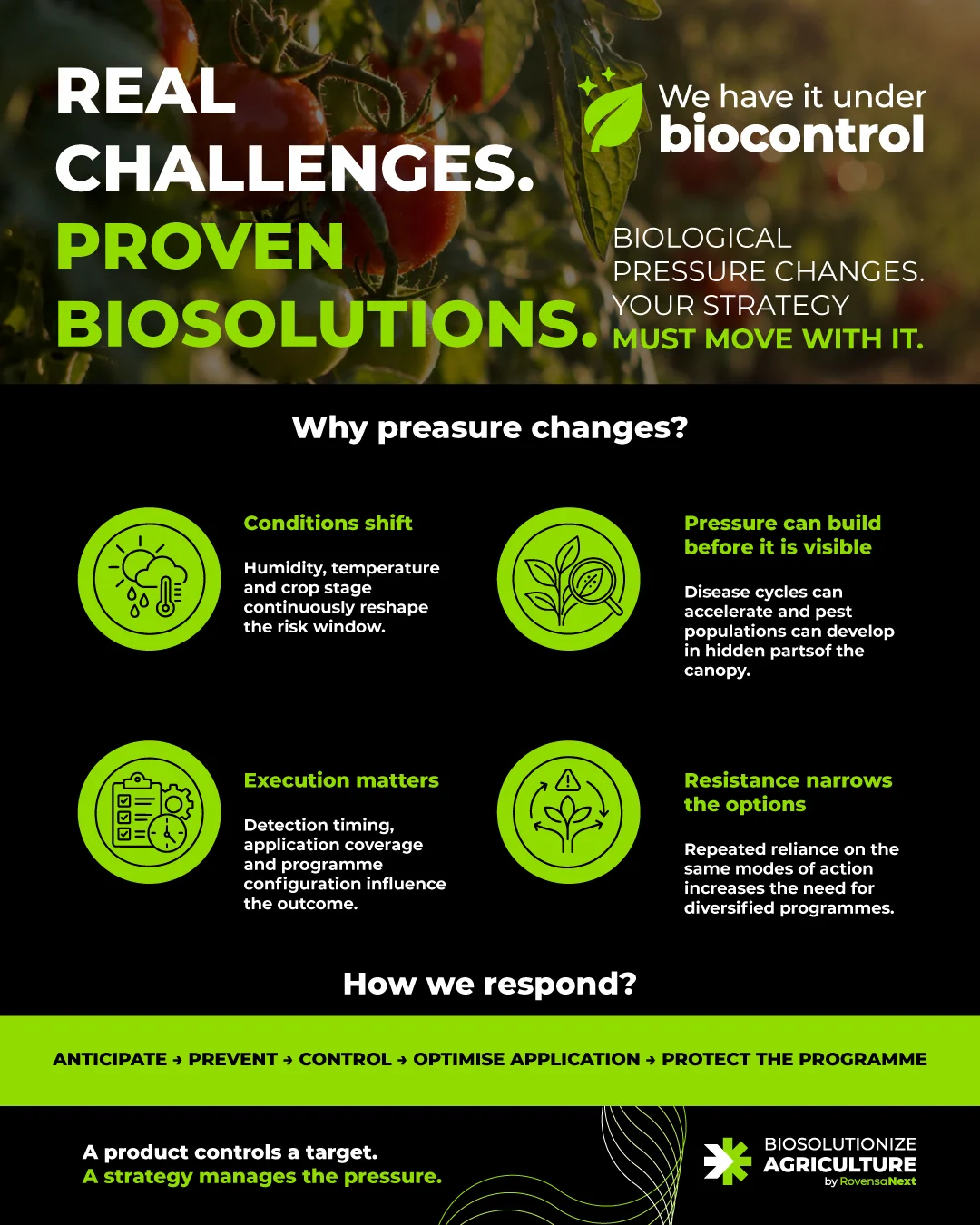
The same pests. Never the same pressure. Humidity, temperature, crop stage, water availability, canopy structure, natural enemies and application quality constantly reshape the risk window. A fixed-calendar approach struggles to keep pace with biological pressure that responds to field conditions—and when symptoms become visible, the crop may already be losing potential.
This is why biocontrol should not be presented as a sequence of isolated products. A product controls a target. A strategy manages the pressure. By anticipating risk, identifying the challenge early, preventing establishment, intervening precisely, optimising application and diversifying modes of action, growers can protect crop performance more effectively.
This campaign marks a natural evolution of Biosolutionize Agriculture. What began by bringing biosolutions closer to the real challenges growers face now moves one step further: from addressing individual problems to understanding how biological pressure changes and building integrated responses around it. The focus remains firmly on the field—connecting knowledge, technologies and complementary solutions to help growers anticipate challenges, act at the right moment and protect crop potential.
Integrated biocontrol for powdery mildew, downy mildew and mites
Powdery mildew, downy mildew and mites differ in biology, symptoms and development, but they share the same strategic challenge: pressure changes with conditions, early detection is decisive, and no single tool can cover every stage of the cycle. Together, they show why growers need an integrated framework rather than three disconnected product stories.
The common objective is clear: control the pressure and protect the potential. That means preserving functional leaf area, photosynthetic activity, crop quality, yield potential and profitability while keeping programmes effective over time.
Powdery mildew: visible on the surface, damaging much more
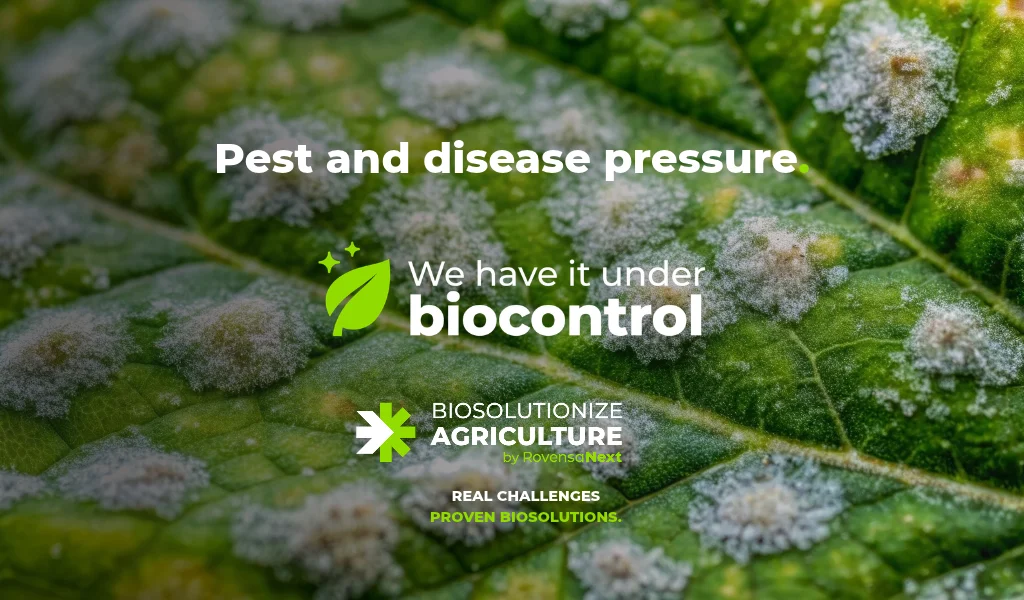
Powdery mildew is recognised by white or grey powdery growth on leaves, stems and sometimes fruit. Although much of the fungus develops externally, specialised structures draw resources from living plant cells. As infection advances, leaves may yellow, curl or age prematurely, photosynthesis declines and crops can lose vigour, uniformity, quality and commercial value.
Its wind-dispersed spores can move quickly within the canopy and across fields, making early recognition and programme continuity essential. Integrated management combines prevention, direct biological control, contact action and rotation. Within Rovensa Next’s global orientation, Ospo Vi55® leads direct control and Prev-Am® according to crop, target and local authorisation.
In the corresponding experimental trials, Ospo Vi55® achieved 79–94% control, with results dependent on application rate and conditions. These efficacy figures are examples linked to specific trials and must always be adapted to local registration and use conditions.
Downy mildew: when conditions turn, pressure moves fast
Downy mildew is caused by oomycetes and is strongly driven by the environment. High relative humidity, prolonged leaf wetness, rainfall or overhead irrigation, together with moderate temperatures, can open a rapid infection window. In susceptible crops, the disease may complete a reproductive cycle in only 4–10 days.
Typical signs include yellow-green chlorotic lesions or oil spots on the upper leaf surface and grey, white or violet sporulation underneath during humid periods. Because the pathogen colonises internal tissues and spreads through water, wind and plant material, anticipation and preventive positioning are especially important.
Integrated programmes should connect prevention, disease suppression, application coverage, crop resilience and resistance management. Portento® supports preventive positioning, Milagrum Plus® provides a control option within integrated programmes, and Prev-Am® or Prev-Gold with Orowet® Technology can contribute contact activity and application performance where authorised. In commercial cucumber trials under high pressure, Milagrum Plus® delivered up to 91% control of disease severity; results varied with conditions and programme configuration.
Mites: small pest, fast-growing pressure
Mite pressure can build without being detected, especially on leaf undersides, crop edges, hotspots and dense canopies. By the time stippling, chlorosis, bronzing, webbing or premature leaf decline becomes obvious, the infestation may already be established and photosynthetic capacity, quality and yield potential may be at risk.
Regular scouting, accurate identification and assessment of species, life stages, population distribution and beneficial organisms are the starting point. Selective intervention, conservation of natural enemies, strong coverage and follow-up monitoring turn mite control into an adaptive IPM strategy rather than a blanket application.
One integrated biocontrol strategy for changing pressure
Integrated pest and disease management brings together biological, cultural, physical and, where needed, conventional approaches. Across powdery mildew, downy mildew and mite pressure, the response can be organised around five connected functions:
- Anticipate: monitor crop and weather conditions, identify pests and disease symptoms, assess risk and decide early.
- Prevent: support crop health and use agronomic, canopy and application practices that reduce favourable conditions for infection or infestation.
- Control: match the intervention to the target, crop, pressure level and timing.
- Optimise application: improve wetting, spreading, adhesion and coverage so solutions reach plant surfaces, sporulating structures and pests in difficult canopy areas.
- Protect the programme: conserve beneficials, diversify tools and modes of action, rotate responsibly and review the crop after treatment.
This is the practical meaning of keeping biological pressure under biocontrol: not a blanket response, but a sequence of informed decisions that adapts to the target, crop, conditions and stage of the cycle.
How biosolutions strengthen the programme
Biosolutions can contribute different functions within an IPM programme. Depending on the formulation, mode of action and authorised use, they can provide contact activity, support application performance, complement biological control and help diversify the programme. Their value is greatest when they are selected for a clear strategic role rather than treated as stand-alone answers.
Orange oil technology: contact only works where coverage reaches
Orange oil-based technologies can contribute contact activity against certain fungal diseases, pests and mites where authorised by the local label. Because performance depends on reaching the target, wetting, spreading and coverage are central to the result—especially on leaf undersides and within dense canopies.
Only Rovensa Next orange oil solutions such as Prev-Am® incorporate the patented and proprietary Orowet® Technology, designed to support wetting and spreading. Across the three pressure chapters, this illustrates a broader principle: performance depends not only on the active ingredient, but also on how effectively treatment reaches the relevant surface, spores, sporulating structures or pest.
Botanical and naturally derived solutions: selective intervention
Botanical and naturally derived crop-protection solutions can provide further options for growers seeking to diversify mite-management programmes. Rovensa Next’s global portfolio includes pyrethrin-based solutions such as Santem®, Tec-Fort® and Xterminator®. Their role depends on the specific formulation, pest, crop and authorised use, and they should be selected in relation to beneficial organisms and the wider strategy.
Availability, authorised uses, targets and recommendations vary by country. Always follow the local label.
Protect beneficials. Protect the programme.
Predatory mites and other natural enemies can play an important role in regulating pest populations. An integrated programme therefore considers not only how to suppress the target, but also how to conserve beneficial organisms and preserve the effectiveness of available tools.
Resistance management is equally important. Repeated reliance on the same mode of action can narrow future options. Rotation, complementary modes of action and accurate application help reduce selection pressure and maintain programme effectiveness over time.
From target control to crop performance
Biocontrol is ultimately about more than reducing a pathogen or pest population. It is about protecting photosynthetic capacity, crop quality, yield potential and long-term farm productivity. As biological pressure changes, the response must remain flexible enough to move with it—across diseases, pests, crops and regions.
The strongest strategy is not defined by the number of products it contains, but by the quality of the decisions connecting them. Monitoring reveals the pressure. Prevention reduces the opportunity. Direct control acts at the right moment. Application quality helps the solution reach its target. Diversified modes of action, beneficial-friendly choices and review protect the programme.
Powdery mildew. Downy mildew. Mite pressure. Different challenges require different tools, but the objective stays the same: anticipate pressure, act with precision and protect crop performance. Whatever the pressure, we have it under biocontrol.