
Why is agri-input efficiency becoming the new standard in sustainable agriculture?
European and global agriculture are facing an unprecedented challenge: producing food profitably while reducing the use and impact of agricultural inputs. Regulatory pressure, rising fertilizer and crop protection product costs, and increasing sustainability expectations are driving a reassessment of traditional production models.
This challenge is further amplified by the ongoing fertilizer crisis, characterized by price volatility, supply instability, and increasing dependency on external inputs. These factors are reshaping growers’ production decisions worldwide.
In this context, international organizations such as the FAO and the European Commission consistently identify input-use efficiency as being key to the future of sustainable agriculture.
Rovensa Next’s integrated portfolio of biosolutions supports growers across the value chain, enabling more efficient and sustainable use of agricultural inputs while maintaining performance. This approach balances agronomic effectiveness, environmental responsibility, and grower profitability.
What is agri-input use efficiency, and why does it matter for growers?
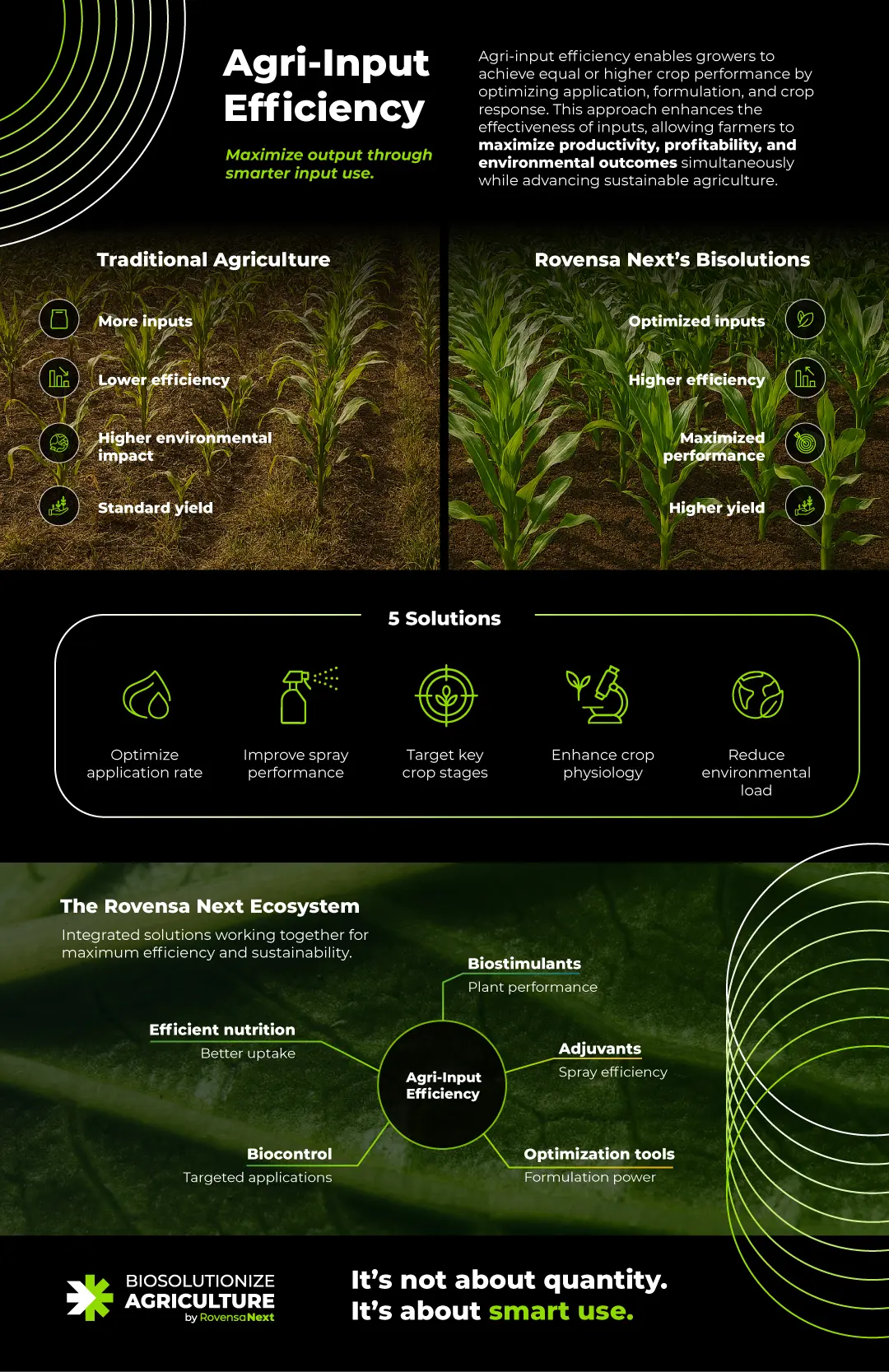
Agri-input use efficiency can be defined as the ability to achieve target crop responses with lower input quantities, leveraging product formulation and application efficiency to maintain efficacy while reducing chemical and nutrient loads in the field.
This concept aligns with the FAO’s definition of technical efficiency in agriculture, which is achieving equal or greater productivity with fewer resources. Agri-input use efficiency matters to growers because it supports consistent yields and crop quality while improving cost efficiency, reducing environmental impact, and optimizing resource use.
In practical terms, this concept is based on these core levers:
- Optimizing application frequency.
- Improving spray coverage and deposition.
- Measuring true physiological crop response.
- Maintaining agronomic efficacy with reduced environmental impact.
By acting on these levers, agri-input efficiency directly supports sustainability objectives such as reducing environmental impact, minimizing nutrient losses, and enhancing the resilience of cropping systems, while preserving crop performance and farm profitability (link)
How biosolutions enable agri-input efficiency in practice?
This framework aligns with Rovensa Next’s integrated biosolutions approach, which enables agri-input efficiency through complementary solution categories, each addressing a specific efficiency lever.
- Biostimulants such as Delfan Plus®, Vegenergy® and Phylgreen® support crop physiology by improving nutrient uptake, metabolism and stress resilience, helping crops convert applied inputs into performance more efficiently. Biimore® is specifically positioned to enhance yield and quality, maximizing the conversion of applied inputs into higher productivity and improved marketable output.
- Adjuvants and spray-conditioning technologies such as Wetcit® are designed to enhance spray performance at the application stage. These solutions improve wetting, spreading, retention, and deposition on the target surface, helping spray droplets overcome physical barriers such as waxy cuticles, dust, and challenging leaf architectures.
- Optimization solutions focused on enhancing nutrient use efficiency, featuring ArmoniKa® as a specialty macronutrient, designed to maximize performance throughout the crop cycle. It improves nutrient availability and plant absorption, supporting more efficient uptake, stronger formulation performance, and consistent results in demanding crop conditions.
- Biocontrol solutions, including orange oil–based solutions powered by Orowet® technology such as Prev-Am®, Prev-Gold® and Oroquin®, together with Tulga® Spinex, Mim®, Oroneem®, Portento®, Ospo Vi55® and Santem®, can be integrated into IPM programs to reduce application frequency, dependence on synthetic inputs, and resistance pressure, while maintaining reliable control efficacy and supporting more efficient and sustainable agri-input strategies.
- Efficient and specialty nutrition solutions, featuring Ultraferro® and TC AZ® designed to enhance nutrient use efficiency. By leveraging advanced chelated technologies, these solutions improve nutrient availability and absorption within the plant, leading to higher yields and better crop quality at optimized application rates.
Together, these biosolutions form an integrated agri-input efficiency strategy focused not on applying more inputs, but on using them more efficiently, which is fully aligned with the principles of the Biosolutionize Agriculture campaign.
Field-validated evidence: what global trials reveal about agri-input efficiency?
1. From concept to evidence: what the data shows
The thousands of international trials conducted on Rovensa Next’s portfolio (2001–2025) provide a robust empirical basis for the concept of agri-input efficiency. Results across crops and regions consistently show that yield can be maintained or increased with fewer inputs when formulation, timing, and application strategies are optimized.
These strategies have amplified both yield and quality in high-value crops, generating field-level returns of over €3,000 per hectare.
Consolidated trial outcomes include:
- Average yield increase: +11.85%
- Maximum documented increases:
- Wheat: up to +36%
- Potatoes: up to +44%
- Maize: up to +33%
- Sugar beet: up to +29%
- Berries (strawberry/raspberry): from +24%–80%
- Tomatoes: up to +38%
- Peppers: up to +19%
- Field-level ROI: from +€30 per hectare to over €7,000 per hectare, depending on the crop and market conditions.
These results have been observed consistently under a wide range of agronomic and environmental conditions using integrated biosolutions programs.
2. Optimizing input use: producing more with less
One of the cornerstones of agri-input efficiency is optimizing how much and how often inputs are applied, without compromising crop performance.
2.1 Optimizing application rate (dose)
A central element of agri-input efficiency is reducing the number of applications per hectare while maintaining crop performance.
Field trials show that well-formulated micro-doses can deliver equal or superior outcomes compared to conventional higher-input strategies.
Examples include:
- Fruit crops (grapes, berries, apples): yield and quality gains of +10% to +52% achieved with low application rates, improving parameters such as color, °Brix, and fruit size.
- High-value vegetables (tomatoes, cucumbers, melons): yield increases of +12% to +40% with optimized micro-dose strategies, including higher fruit numbers and improved uniformity.
- Intensive crops (potatoes, onions): marketable yield improvements of +26% to +209% driven by better tuber/bulb size distribution and input efficiency with reduced application intensity.
- These results demonstrate that application rate optimization is about precision, not under-application.
2.2 Optimizing application frequency
It is the appropriate time for application due to the pest’s developmental stage or climatic conditions that are favorable to pest or disease development.
Regulatory frameworks increasingly encourage reducing application frequencies to lower environmental exposure. Trials indicate that targeting key BBCH stages optimizes application schedules without compromising results.
Well-timed strategies based on one or two applications have delivered performance comparable to that of traditional programs using three or four applications, particularly when integrated into broader agronomic programs.
2.3 The role of IPM and biocontrol
IPM and biocontrol strategies play a pivotal role in this optimization process. Rovensa Next’s biocontrol solutions, embedded within Integrated Pest Management (IPM) programs, enable a reduction in application frequency by combining preventive, biological and targeted interventions. Products such as Prev-Am®, Portento®, Ospo Vi55® and Santem® help maintain consistent pest and disease control while reducing reliance on repeated chemical applications, decreasing resistance pressure and minimizing environmental impact. This IPM-driven approach directly supports sustainable agriculture goals by achieving efficacy with fewer, more precise interventions.
3. Why do formulation and application quality matter?
Efficiency is not only about how much is applied, but how well the produce works once applied.
According to EFSA, product efficacy depends on:
- Formulation quality
- Spray deposition
- Stability under field conditions
Optimized formulations and adjuvants:
- Improve coverage and absorption.
- Reduce drift and wash-off losses.
- Ensure more consistent crop response.
In this context, every application must deliver maximum value.
4. Moving beyond yield: measuring real crop performance
Yield alone does not fully reflect efficiency.
True agri-input performance must be assessed through physiological and quality parameters, such as:
- Protein content
- Oil accumulation in oilseed crops
- °Brix, firmness and shelf-life in horticulture and fruit crops
- Root development and stress tolerance
These parameters reflect the true capacity of crops to transform applied inputs into marketable value.
5. When efficiency drives profitability
Field data confirm that agri-input efficiency delivers tangible economic benefits:
- Potatoes: up to +€1,500 per hectare
- Onions: +€2,290 per hectare
- Blueberries: >€5,800 per hectare
- Maize: +€210 per hectare
These results confirm that improving agri-input efficiency not only enhances profitability but also contributes to more sustainable production systems with reduced input intensity.
From reducing inputs to applying them better
Agri-input use efficiency is about maximizing the performance and value delivered by every application. Field evidence shows that yield, quality, and profitability can be maintained or improved while reducing overall input intensity.
Rovensa Next’s integrated biosolutions portfolio including biostimulants, adjuvants, biocontrol and efficient nutrition supports growers with practical, evidence-based approaches to more efficient and sustainable agriculture, fully aligned with the principles of Biosolutionize Agriculture.